
LUXART XD

Some of the most overlooked contributors to medical science have sacrificed more than we realize, and they're probably not who you think.
When Aaron's 13-year-old daughter asks a surprising question about the lab rats used in scientific research, an ordinary car ride becomes an unexpected conversation about sacrifice, compassion, and the value of life.
📬 Be a part of the newsletter
*Dive deeper and connect with Aaron on...
The Team:
Story Created & Performed by: Aaron Calafato
Senior Audio Engineer: Ken Wendt
Additional Vocals: Cori Calafato
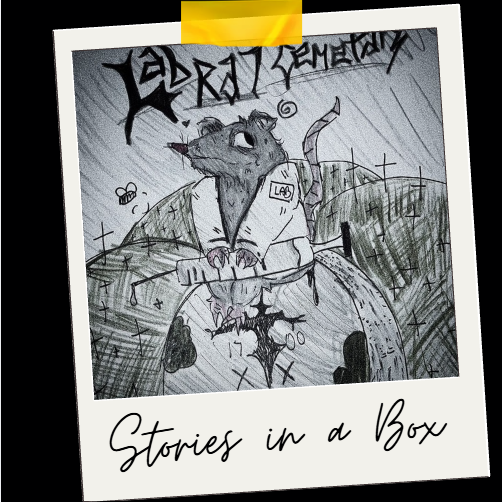
Art: LuxArtHD
Original Theme Music: thomas j. duke

Follow & Binge The 7MS Catalog
TRANSCRIPT
My daughter said something to me that I still have not recovered from, and I'm still thinking about it. And when I share it with you, I'm betting the same thing will happen to you.
In 2024, Imperial College London reported 101 non-recovery procedures performed on rats. So this means that at one university alone, in a single year, 101 rats were put under anesthesia for research purposes, for experiments, and they never woke up.
Another scientific report from 2021 estimated that 111.5 million rats and mice combined were used annually for experimentation, advancements in medicine, research, health, safety, and the list goes on.
Folks, think about that.
That's every year.
So this brings me to my daughter and our conversation.
I don't know what the topic was originally. I think we were going over her classes. We do that when we drive home. I have her go through each class, and we talk about what subjects she's studying. And she loves social studies.
We were talking about Greek mythology, Rome, history, and all this stuff.
And somehow, we got onto the topic of heroes. People who've risked their lives, whether through civil disobedience, sacrifice, or service.
We were talking about unsung heroes. People serving in the military, people on the front lines, teachers, firefighters, police officers, and so many others doing work that saves lives.
And when I brought that up, she said something to me.
She said, "You know how they do experiments on rats for life-saving drugs? Whatever happens to the rats when they die?"
I said, "What do you mean?"
She said, "Well, they do experiments, right? And that means sometimes the experiments go wrong. And in essence, even though they're not choosing to sacrifice themselves, they are, in fact, being sacrificed for our benefit."
And I was like, "Yeah, I guess that's right."
And the thing is, friends, I never thought about that before.
I knew there were lab rats and other rodents that take part in testing, but I never thought about it to that extent.
And I'm looking over at my daughter, thinking, what an insight.
And she said, "You know, I think it makes sense. But at least some of our first responders and some of our folks, don't they get a little something too?"
I said, "What do you mean? What are you supposed to do, send their families a care package?"
She goes, "No. Do they have any sort of memorial for the rats? Like a special memorial rat graveyard? A cemetery? A banner? A ribbon? Anything written or documented? A day? A holiday? A saying? A phrase? Something that just says:
'Hey, we know that you're rats, but you have life too. And we know that we've done some stuff here, as humanely as possible, hopefully, but we utilized our power over you to experiment so that we're okay. And in the course of doing that, you've made a sacrifice.'
Think about the impact on the rat community."
So as we're driving and talking about this, my first reflex was to do what I did when she was younger, which would be to sort of make up a story.
Not lie, but if she's four and she's asking, "Hey, Dad, what happens to the rats when they go through experiments for science?"
I would probably say, "Yeah, they throw a little rat party. Maybe they have little rat hats, and they have their favorite snack or something like that for their families."
Or maybe I'd say they don't ever hurt the rats. They just do basic experiments that don't cause death.
I don't know what I would say.
But now she's 13.
She's smarter than me. Her intelligence level is through the roof.
And so I'm looking at her going, "I have to tell you the truth. I don't know how they dispose of the rats."
And I'm wondering, the people who do that, maybe they're so numb to it, do they even say a prayer?
I'm not judging.
I'm just saying, is there any sort of sentiment? Memory? Thought?
I know I haven't given it one iota of thought my entire life because I haven't even considered it.
And then she said, "You know, how hard would it really be to just have a national day that says:
'Hey, we just want to thank all of the rats who've sacrificed for our health and our well-being. We know it wasn't your choice, but your sacrifice isn't lost on us.'"
And I couldn't be more proud of my kid.
Honestly.
As we drove home, I kept thinking about this.
I'm always coming from the position of a parent. Like I know. I have clarity. I've been around. I have experience.
And I think so much of that is true, right?
There are things you learn as you get older that you simply don't have access to or understand when you're younger.
But I also think we, as adults, are a little too full of ourselves.
I think there's something that can be lost during that transition from childhood to adolescence to adulthood.
There's a clarity that kids have. Not just my daughter, but so many kids.
A clarity about some of the most important curiosities, questions, thoughts, and the dignity of seeing all living things as important.
I think we lose sight of that.
I know I did.
As we get older, our minds become filled with our own problems, the bigger problems, and all the problems right in front of us.
And sometimes we don't even think about what happens to the rats.
You know?
Could they just have a little spot?
Some little patch of grass of their own for the ones that didn't make it, or were part of those experiments?
And maybe they don't have the wherewithal or the intelligence to go visit the ones that have passed and perished.
But hell, if they opened up something like that, I know one of the first road trips my daughter and I would take.
It would be to the Rat Memorial.
I'll talk to you next week.