
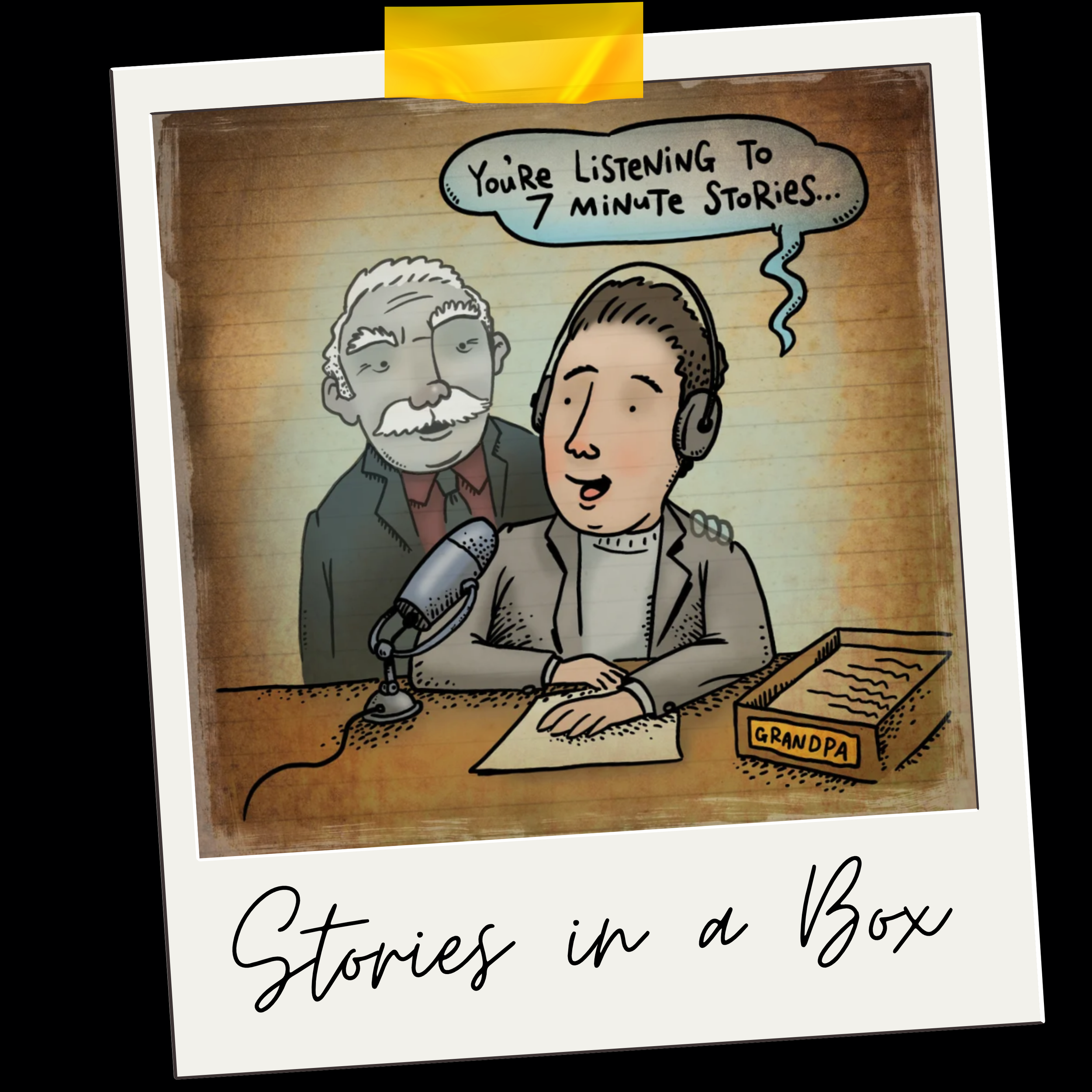

A locked desk drawer. Hundreds of short stories. A side of his grandfather Aaron Calafato never knew.
Growing up, Aaron’s grandfather taught him how to captivate a room, turning old speeches into storytelling lessons around the living room. Years later, a discovery shared by Aaron’s father revealed a hidden collection of stories, decades of rejection letters, and a creative dream that connected three generations.
Plus, Aaron welcomes Meminto Stories as the presenting sponsor for the remainder of season seven of 7 Minute Stories. Meminto helps turn personal memories into printed books through guided questions. To celebrate, two winners will receive a free Meminto book to preserve their own stories in a Thanksgiving giveaway.
📬 Be a part of the newsletter
*Dive deeper and connect with Aaron on...
The Team:
Story Created & Performed by: Aaron Calafato
Senior Audio Engineer: Ken Wendt
Additional Vocals: Cori Calafato
Original Theme Music: thomas j. duke

Follow & Binge The 7MS Catalog
TRANSCRIPT
Opening Announcement
Hey, friends. I got a chance to talk several times over the last few months with a gentleman named Albert Brückmann. He started a company called Meminto Stories. They help turn people’s memories into printed books through guided questions. And one of the things that stuck with me during our chats was the story about his grandmother.
She had left behind memories written on loose pieces of paper. And so those pages, her preserved story, were part of what inspired him to start this company.
As listeners to this podcast feed, you all know I spend a ton of time telling you seemingly everyday stories and sharing the extraordinary things within them.
But people do tell me all the time, “Hey, Aaron, I love your storytelling, but who would want to hear or read my story?”
Well, probably the most important people in your life.
I mean, just because you don’t plan to share a story on a podcast, on the radio, or as a novel, it doesn’t mean it’s not worth preserving. In fact, I would argue those stories are just as precious, or even more precious.
So that’s why I’m very, very excited and happy to share that Meminto Stories will be the presenting sponsor for the rest of season seven of 7 Minute Stories. That takes us all the way through January 1st.
I want to thank Albert and his team. Really, because of them, the stories on this show won’t have any commercial interruptions, and they’ll be available to all of you and whoever finds us next.
Oh, and we’re also doing a Thanksgiving giveaway. Two families or two people will get to turn their stories into a Meminto book for free, and yours could be one of them. All you have to do is enter the giveaway.
I’ll keep telling you about it through the months of October and November. Details, deadlines, and how to enter are going to be in the episode description. Look out for that.
As we kick off this presenting sponsorship, I thought of a perfect story to share with you all about my grandfather and secret stories he had written that we only discovered later.
Please enjoy “Stories in a Box.”
Stories in a Box
You know, people say all the time, “He or she can walk into a room and light up a room,” or influence a room, change the dynamic.
Legitimately, that was my grandfather.
He could walk into any space, private, public, social, family, friends, one-on-one, and he would captivate. He would transport you with his words.
Maybe I didn’t realize it, but that’s when I really fell in love with the ability to tell a story. He laid the foundation for that.
But what I didn’t know, and what you’re going to find out in a few minutes, was a secret. I didn’t realize how much he actually loved the art of storytelling, maybe as much as or more than me.
But before we get to that, let me give an example of what my afternoon with my grandfather, or an evening on a weekend when I’d be visiting, would be like, okay?
So we’d get to his house. My grandmother, he, and I would be there. We’d have this amazing Italian dinner: sausage, meatballs, pasta, salad, a big glass of milk. They always made me drink tons of milk.
I gulped down this ice-cold glass of milk, and my grandmother would be cleaning up in the kitchen.
My grandfather would go out into the living room, and he would tell me to pull out a chair. He would sit in his chair, and he goes, “I want you to stand on this chair and face me.”
Then he would walk down the hallway, and he would come back with a speech that he had written. He worked for a company called East Ohio Gas.
You see, he was the first person in his family ever to go to college, ever to get a white-collar job. He worked his way up in his career into the marketing department and into a leadership role there, and he would give speeches all the time.
So he brought one of these old speeches out to me. It was written on a typewriter. It had coffee stains all over it, and it would have the date on the front, like “1968 East Ohio Gas Annual Review.”
And I’m this 10-year-old standing on a chair, and my grandfather and my grandmother were the audience members. He would say, “Now, do the speech, Aaron.”
It was this 10-page speech. I’d start from the very beginning, and I would say something like, “Ladies and gentlemen, thank you so much for being here this evening. You know, this company and the people in it have worked year after year, and now you’re getting the recognition you deserve.”
Something like that. I’m paraphrasing.
But he would stop me line by line. He would say, “Wait, wait a second. Don’t say it like that. Don’t just read it. Are you talking to the people in the room? Then let them know they’re alive.”
He would say, “So when you say, ‘Ladies and gentlemen,’ it’s not ‘Ladies and gentlemen.’ It’s ‘Ladies and gentlemen.’ And when you say thank you, make sure you’re thanking them. ‘Ladies and gentlemen, thank you so much for being here this evening.’”
And he would say, “When you’re talking about the company and you say, ‘The people in this room are part of this company,’ let them know they’re part of it. ‘The people in this room make up this company.’
“And then when you’re talking about the work that they put in, you’re not just saying, ‘Oh, you worked really hard.’ You’re saying, ‘Everyone in here has worked year in and year out, and now you’re getting the just recognition you deserve,’ or something like that.”
So it would take hours, but I would have to go through line by line. At the end of the speech, when I would go through without him stopping me, they would give me a rousing round of applause, and I knew I had done well.
But what I didn’t realize was maybe my grandfather was preparing me for something bigger, molding me for something that he always wanted.
And I say this because my dad, my father, just told me a story about his dad, my grandfather.
My dad describes this day when he was a younger kid, and his parents had just gotten divorced. My father is in his dad’s office that had just been emptied because he moved out.
My dad was probably trying to find a relic or find some sort of connection with his dad after this happened, and he found a key to his desk, my grandfather’s desk.
He opens up all these drawers with the key, and he’s pulling the drawers out, and he’s looking for things. And through all this office stuff, he finds a huge drawer filled with hundreds of short stories that were written and typed by my grandfather.
My dad pulls all these stories out, and for hours he’s sitting in this office, and he’s just reading, connecting with his own father in a way that he couldn’t imagine.
My dad told me, “Aaron, these stories were incredible. Some of the most well-written, compelling short stories I’ve ever read.”
And my dad’s crying, reading these stories.
More interesting, he found on the front of every one of these stories a submission letter. These were all stories that were submitted to the big national publications of the day: The New York Times, The New Yorker, Vanity Fair.
My grandfather, for decades, was trying to get his storytelling out there and be published for a larger audience.
I mean, he had been doing this for decades. It’s so connective to me because I didn’t even know that, and that’s what I’ve been doing for the last 10 or 15 years.
But on the back of every one of these stories, my dad found a rejection letter written to my grandfather.
Every one of his stories had been submitted, and even though they were compelling, every single one of them had been rejected.
And maybe that rejection was the reason they were sitting locked up in a drawer, never to be found or seen again.
About a month ago, I got word that National Public Radio was going to be spotlighting, on one of their hit shows, one of my seven-minute stories, which you’re listening to right now.
When I got that news at the time, I was so excited. I knew what it would do. It’d broaden an audience base. It was the same thing my grandfather wanted, and I didn’t even know about it.
And so now, when I listen to the podcast or when I heard myself on the radio, I think to myself, “You know, it wasn’t just me out there telling a story. My grandfather helped build the foundation for everything I do. It wasn’t just me on the air getting featured. It was us, he and I.”
And wherever he’s at in the ether, wherever he’s at in the universe, his energy, I just want you to know that, Grandpa, they heard you.
You made it.
Your stories aren’t locked in a box anymore.
Your stories are inside of me, and this is just the first step.
They heard you, Jojo.
I love you.